Elite elevators and Nibav Lifts: liquidation warnings, missing lifts, and the unreliability retirees can’t afford
A lift in a two-storey home is often sold as a calm, sensible purchase. Keep the bedroom upstairs, keep the kitchen downstairs, keep your routines. But the investigation aired by A Current Affair shows what happens when that promise meets a collapse: retirees paying life savings, then being left with empty spaces, locked cabins, and no clear way forward. (9Now)
Elite elevators liquidation: what the investigation says happened to retirees who paid in full
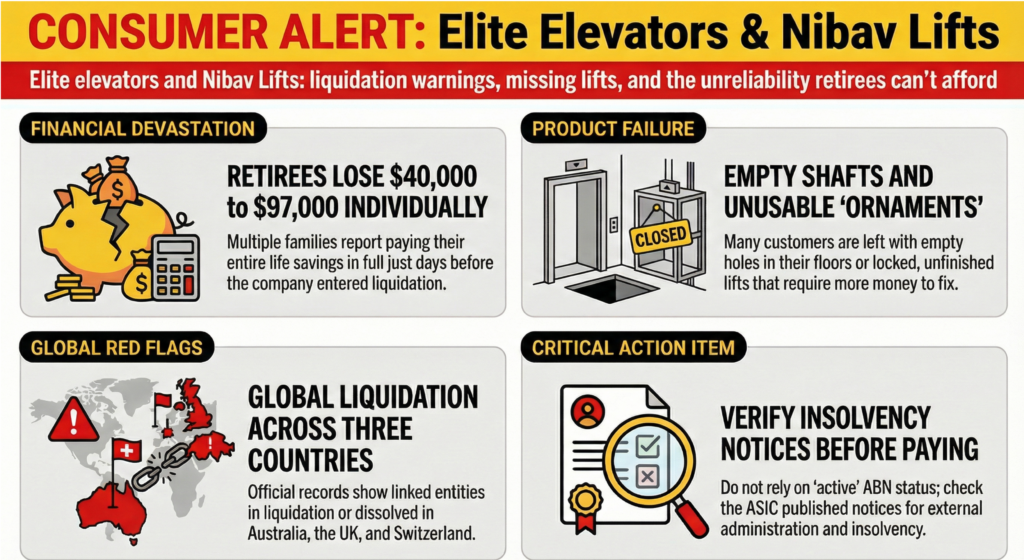
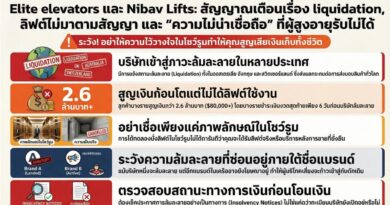
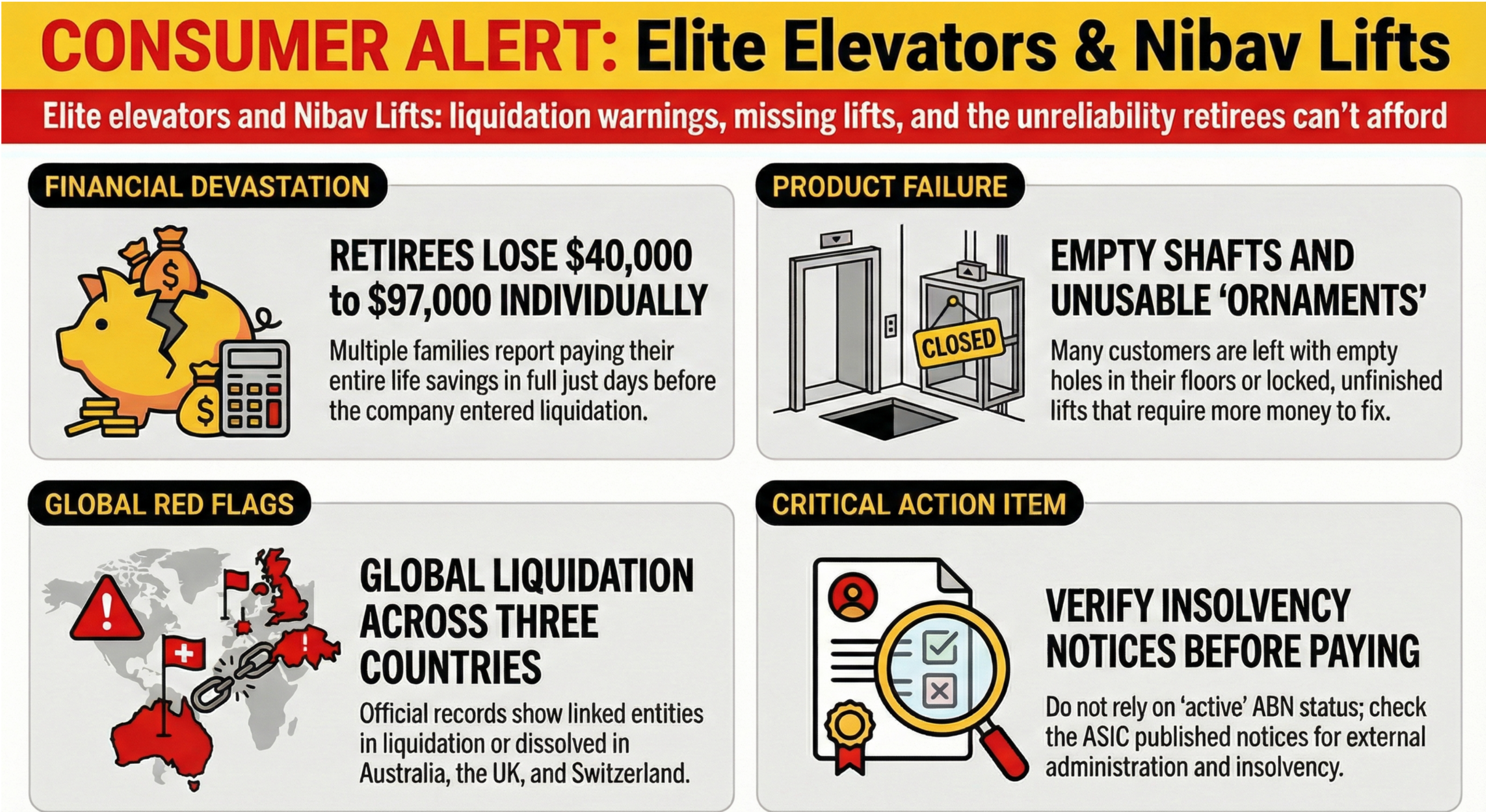
In the broadcast, one couple says they lost $80,000, plus $17,000 for concrete. Another says they’re out $42,000. Another couple says they paid $67,000, with the final payment made six days before liquidation. These aren’t small disputes over timing. They’re life-changing sums, often paid by people who don’t have decades of earning runway left.
In Melbourne, Veronica and Dudley are shown with nothing installed. Dudley is turning 89. They bought because stairs were becoming a daily grind. The punchline of the segment is grim: “This is where your 72 grand elevator should be.” (YouTube)
“Paid six days before liquidation”: why timing is a red flag in Elite elevators complaints
That “six days” detail matters because it captures the worst-case scenario for consumers: you pay in good faith, the business fails right after, and your leverage evaporates. Once liquidation starts, projects can stop immediately and customers can be pushed into a creditor line where outcomes are uncertain.
What liquidation means for customers: why refunds and installations can disappear overnight
Official notices from Australian Securities and Investments Commission show ELITE ELEVATORS CORPORATION PTY LTD (ACN 638 687 671) listed “In Liquidation”, with a notice published on 2 December 2025. (PublishedNotices)
A separate consumer trap sits in plain sight: the Australian Business Register can still show an ABN as “active” even when a company is in liquidation. If a buyer only checks one screen and stops there, they can miss the signal that really matters. (ABN Lookup)
Showroom trust, then silence: how Elite elevators sales demos can hide delivery risk
Alexander and Pauline’s story explains why these cases keep happening. They visited a showroom, rode the lift up and down, and felt it was legitimate. Pauline describes severe health issues and urgency. Then, months after paying, they say the company went bust and messages to the liquidator went unanswered.
That “showroom trust effect” is powerful. A demo proves a unit exists. It does not prove your unit will be delivered, installed, commissioned, and supported for years.
Operational unreliability vs mechanical faults: the hidden risk with Elite elevators and Nibav Lifts
When customers say a lift is “unreliable,” many people picture breakdowns. In these stories, the unreliability is deeper and more damaging:
- Delivery reliability (will anything arrive?)
- Completion reliability (will installation and handover finish?)
- Support reliability (will anyone answer after payment?)
Debbie’s case shows this perfectly. She did receive a lift, but it’s locked and unfinished, with installation scheduled for the week the company went into liquidation. She says she may need to pay more out of pocket to complete the last stage with someone else.
Nibav Lifts and Elite elevators: why the “sister brand” link matters when a company collapses
In the segment, the reporter says they looked online and saw Elite Elevators and Nibav Lifts still advertising, which raises a blunt question: how many new buyers might sign while others are stuck?
On the “connected brands” point, business media has described Nibav Home Lifts as “part of Elite Elevators.” (YourStory.com) And industry coverage and promotional material commonly presents “Nibav Lifts & Elite Elevators” side by side, reinforcing the perception of a shared commercial story.
Why does that matter for consumers? Because when brands are linked in market positioning, leads, sales teams, or ownership narratives, customers can slide from one name to another without realising they may be stepping into the same risk environment.
Nibav Lifts UK dissolved and Nibav lifts Switzerland in liquidation: official records that raise caution
Outside Australia, corporate status records add more warning signals around Nibav Lifts:
- The UK listing for Companies House shows NIBAV LIFTS LIMITED (14293507) as Dissolved, dissolved on 14 January 2025, with a final Gazette notice recorded in the filing history. (Companies House)
- In Switzerland, Nibav lifts Switzerland GmbH is shown as “in liquidation” on Moneyhouse. (Moneyhouse)
These records don’t explain why each entity ended up there. But they do underline a practical point: a home lift is a long-term service product. If the supplier’s corporate footing is unstable, the customer inherits that risk.
How to protect yourself before buying: milestone payments, legal checks, and suitability proof for home lifts
If you’re shopping for a home lift, use a payment plan that assumes things can go wrong:
- Check insolvency notices, not only registrations. ASIC points consumers to its published notices site for external administration and insolvency notices. (ASIC)
- Get suitability in writing. Especially for wheelchair access. The broadcast includes an allegation from a former employee that “the impossible” was promised, including a wheelchair user sold a lift unsuitable for wheelchair access. (YouTube)
- Ask who finishes the job if the seller disappears. Name the fallback installer and service pathway before you pay the final invoice.
Because the scariest outcome isn’t a lift that breaks. It’s a lift that never becomes usable at all. (YouTube)