How do Cibes Lift, Kalea Lift, Antera Lift, Ascenda Lift, and Aritco compare in Thailand?
TL;DR: Home lift brands in Thailand, simply explained
- Who has a direct company in Thailand?
Cibes Lift, Kalea Lift, Antera Lift, and Ascenda Lift.
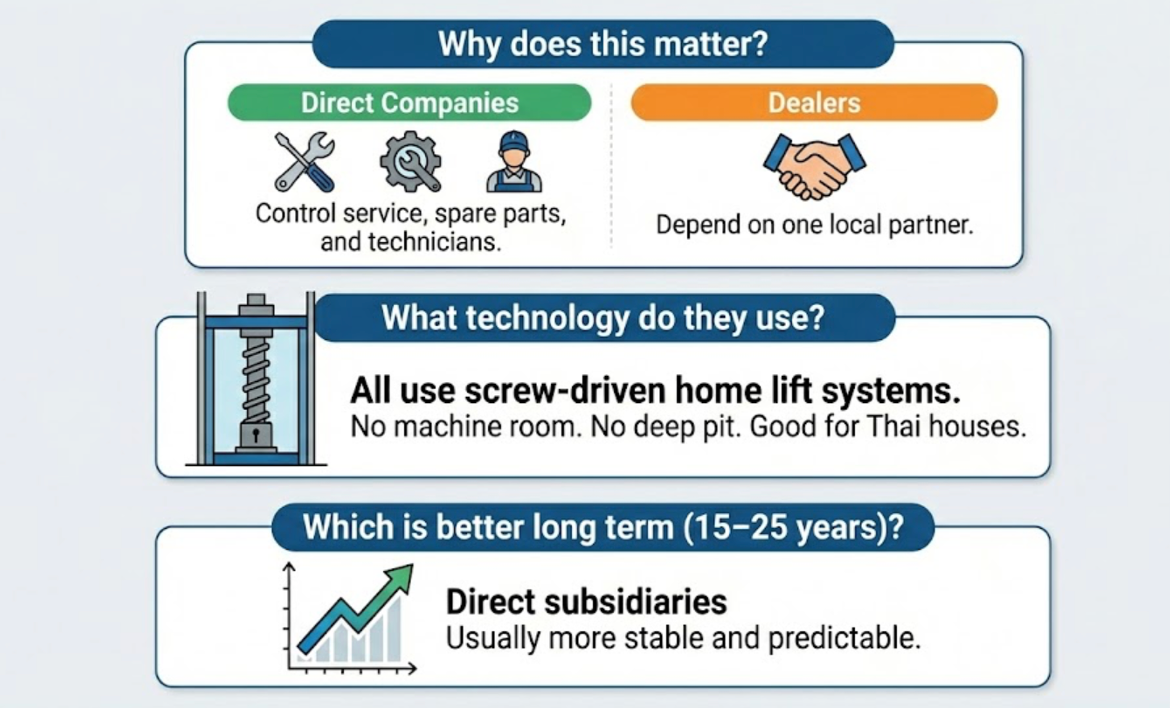
Aritco uses a dealer. - Why does this matter?
Direct companies control service, spare parts, and technicians.
Dealers depend on one local partner. - What technology do they use?
All use screw-driven home lift systems.
No machine room. No deep pit. Good for Thai houses. - Which is better long term (15–25 years)?
Direct subsidiaries are usually more stable and predictable. - Which gives more usable space?
Cibes, Kalea, Antera, Ascenda focus on square cabins.
Easier for wheelchairs and daily use. - Installation time?
A few days for all brands. Low disruption. - After-sales service difference?
Direct brands = factory-trained teams and local spare parts.
Aritco service depends on dealer strength. - Price transparency in Thailand?
Direct brands start around 599,000 THB with clear steps.
Dealer pricing can vary. - Best for aging families?
Cibes, Kalea, Antera, Ascenda offer wider model choices.
Comparison in Thailand
In Thailand, several well-known home lift brands coexist, but they operate under different structures and philosophies. Understanding these differences helps homeowners make a long-term decision, not just a short-term purchase.
The main distinction is not only product design. It’s how each brand is represented locally, how technology is maintained over time, and how well the solution fits Thai homes and families.
Which of these brands operate as a direct subsidiary in Thailand?
Cibes Lift, Kalea Lift, Antera Lift, and Ascenda Lift are all supported through a direct Thai subsidiary started in 2016 and with over 1,000 lifts sold to date. This means the local operation works directly with the factory, without an intermediary dealer.
Sales, installation, service, spare parts, and technical decisions are handled locally by a dedicated team. Product updates and safety improvements follow factory standards more closely.
Aritco, on the other hand, operates in Thailand through a dealer model, not a direct subsidiary. The local partner represents the brand but does not own or control the factory relationship in the same way.
How does local structure affect long-term ownership?
For a product expected to last 15 to 25 years, structure matters.
A direct subsidiary typically offers more consistent service processes, clearer accountability, and faster technical escalation. Spare parts planning is done locally, with factory alignment.
With a dealer model, long-term experience depends heavily on the dealer’s stability, size, and technical depth. This can work well, but outcomes vary more over time.
For homeowners planning ahead, consistency often outweighs short-term convenience.
What technologies do these brands use for home lifts?
Cibes Lift, Kalea Lift, Antera Lift, and Ascenda Lift all use screw-driven technology designed specifically for residential use.
This system does not require a machine room, deep pit, or overhead shaft. The drive system is integrated into the lift structure, making it compact and stable.
Aritco also uses screw-driven technology for its home lifts. In this area, the core principle is similar across brands, though implementation details and update cycles differ.
How suitable is screw-driven technology for Thai homes?
Thai homes often have space constraints, slab limits, and renovation restrictions. Screw-driven lifts suit these conditions well.
They can be installed in existing houses with minimal structural change. Power requirements are low, and systems are easy to maintain in residential environments.
Compared to hydraulic, traction, or vacuum systems, screw-driven lifts adapt more naturally to Thai housing realities.
How do these brands compare in terms of usable space?
Usable space inside the lift matters more than footprint alone.
Cibes Lift, Kalea Lift, Antera Lift, and Ascenda Lift focus on square or near-square cabins. This maximizes standing and turning space, especially for wheelchair users or mobility scooters.
Aritco models also aim for compact footprints, though some designs prioritize visual form over interior flexibility. The experience can feel different depending on user needs.
For daily use, comfort inside the cabin often defines satisfaction.
How do installation and disruption levels compare?
All five brands are designed for residential installation, not commercial shafts.
Screw-driven lifts from Cibes Lift, Kalea Lift, Antera Lift, Ascenda Lift, and Aritco can usually be installed within a few days. No deep pit or machine room reduces disruption.
The difference lies less in installation time and more in coordination. Direct subsidiaries often manage the full process internally, while dealer-based installations depend on partner workflows.
How does after-sales support differ in practice?
After-sales support is where differences become clearer over time.
For Cibes Lift, Kalea Lift, Antera Lift, and Ascenda Lift, technicians are trained under factory standards, and spare parts are managed locally but set by our Swedish HQ. Communication stays within one organization.
For Aritco, after-sales quality depends on the local dealer’s structure and resources. Some dealers perform strongly, others face scaling challenges as installations grow.
Over a long ownership period, this affects reliability and response time.
How transparent is pricing across these brands in Thailand?
Pricing transparency is influenced by representation.
Brands operating through a direct subsidiary tend to offer clearer, more predictable pricing structures. Entry-level solutions across Cibes Lift, Kalea Lift, Antera Lift, and Ascenda Lift start from around 599,000 THB, with defined steps based on size and configuration.
Dealer-based pricing may fluctuate more due to import timing, exchange rates, and dealer margins. This is not inherently negative, but it adds variability.
For families planning ahead, predictability can be important.
How well do these brands support Thailand’s aging population?
Thailand’s population is aging quickly, increasing demand for safe and adaptable home mobility.
Cibes Lift, Kalea Lift, Antera Lift, and Ascenda Lift collectively cover a wide range of needs, from compact two-floor solutions to wheelchair-accessible models. This breadth supports early planning and gradual lifestyle changes.
Aritco also serves accessibility needs but typically offers a narrower locally available range, depending on the dealer.
Coverage across budgets and home types matters as demand grows.
How do sustainability and long-term use compare?
All five brands emphasize low energy consumption and residential safety.
Screw-driven lifts consume power only when moving and run on standard household electricity. Components are built for long service life, and some models can be dismantled and reinstalled in a new home.
The main difference lies in long-term support planning, which is easier to control under a direct subsidiary structure.
What should Thai homeowners focus on when choosing?
The best choice depends on priorities.
Homeowners should consider local presence, long-term service reliability, usable space, and how well the lift fits their home layout.
Brand familiarity matters less than support structure and suitability for real living conditions.
What does this comparison say about future-proof homes in Thailand?
Future-proof homes reduce risk and stress over time.
As Thailand’s population ages, screw-driven home lifts supported by strong local organizations are becoming a practical part of residential design.
Understanding how each brand operates locally helps families choose a solution that will still work well years down the road, not just on installation day.